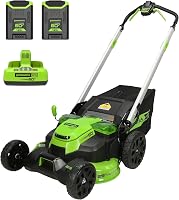
WORX vs Greenworks Lawn Mowers: Which Is Better? (October 2026)
For a WORX vs Greenworks lawn mower choice, pick Greenworks 40V for small, divided yards, WORX WG752 for open lawns and side discharge, or Greenworks 60V for a compact brushless mower that fits compatible 60V tools.
On this page (10 sections)
- WORX vs Greenworks lawn mower: which should you choose?
- Which mower cuts more grass per pass?
- How do mulching, bagging and discharge change the choice?
- Which cutting-height range suits your grass?
- Which battery platform fits your tools?
- How much lawn can you mow on one charge?
- Which mower is easier to push, move and store?
- How should you set up and care for these cordless mowers?
- What buying mistakes should you avoid?
- Which WORX vs Greenworks lawn mower fits your next mow?
For a WORX vs Greenworks lawn mower choice, pick Greenworks 40V for small, divided yards, WORX WG752 for open lawns and side discharge, or Greenworks 60V to match compatible 60V tools.
All 3 are cordless push mowers, so you supply the effort that moves them across the lawn. The useful choice is between a smaller mower that turns easily and a wider mower that covers open ground with fewer passes.
Start with your lawn's shape, the height you want to maintain and the route from storage to grass. Those details can matter more than the voltage printed on the mower.
 Best for small divided yards
Greenworks 40V 16-Inch Push Mower (25322)

WORX vs Greenworks lawn mower: which should you choose?
Choose Greenworks for compact handling or the WORX WG752 for wider coverage and more clipping options. Within Greenworks, your existing batteries and preferred grass height help settle the choice.
WORX vs Greenworks lawn mowers: who should buy each?
The Greenworks 40V is the clearest fit for a small lawn broken up by planting beds, trees or paths. It also makes sense if you already have compatible batteries and want to keep using the same charging setup.
Skip it if broad, straight mowing runs make up most of your yard. A narrow mower adds passes, even when it is convenient around individual obstacles.
The WORX suits buyers with open grass and room to turn at the ends of rows. It is also the choice here if you want to discharge clippings rather than always mulch or collect them.
Skip the WORX if you must regularly lift a mower over steps or move it through cramped storage. Buyers who need powered help moving uphill should also look beyond these push models.
The Greenworks 60V suits a household already building around compatible 60V yard tools. Its brushless motor gives it a separate reason to consider it even if you are starting without batteries.
Skip it if your preferred mowing height exceeds its upper setting. A higher-voltage badge does not make up for a cutting-height range that fails to suit your lawn.
For the broader choice between battery systems and mower types, start with our cordless lawn mower buying guide.
Which mower cuts more grass per pass?
The WORX cuts the widest path, making it the better fit for long, open rows. The Greenworks models trade some coverage per pass for smaller bodies.
Actual cutting widths are 20 inches for the WORX, 16.14 inches for the Greenworks 60V and 15.67 inches for the Greenworks 40V. The model names use rounded mower sizes, so compare actual cutting widths when judging coverage.
The difference between the two Greenworks cutting paths is small. Battery platform, height range and motor type give you stronger reasons to choose between them.
Match the mower to your hardest turn
Measure the narrowest opening along your mowing route, including gates and shed doors. Use overall mower width for clearance because the cutting path does not include the full body.
Allow room for your hands and for turning, too. A mower that barely fits through a gate may still be awkward beside a fence or around a raised bed.
On open lawns, walk straight rows with a small overlap so you do not leave strips. Around beds, plan turns that avoid repeatedly dragging the mower backward through the same corner.
For a yard with several small grass sections, our small-yard mower guide can help you weigh compact size against mowing time.
How do mulching, bagging and discharge change the choice?
Choose WORX if you need all 3 clipping modes; choose either Greenworks if mulching and bagging cover your routine. The useful extra is the mode you will actually use.
Mulching leaves finely cut grass on the lawn. It works best when you mow often enough that the mower is processing short clippings rather than large amounts of long grass.
Bagging collects clippings for removal and can help when you do not want loose grass carried onto paths or into the house. Remember that emptying the bag adds stops and gives you collected material to manage.
The WORX also supports rear side discharge with an included chute. That gives you another way to release clippings, but it does not remove the need to mow at a sensible pace.
Keep discharged material away from people, pets, vehicles and paths. Follow the manual for chute placement and keep all guards fitted.
If you are unsure which routine suits your lawn, read what mulching means on a lawn mower. Avoid choosing a mower for extra attachments that will stay unused in storage.
Which cutting-height range suits your grass?
Choose a mower whose height range covers your lawn's needs, rather than the one with the most adjustment positions. Grass type and season should guide your target height.
The Greenworks 40V adjusts from 1.25 to 3.75 inches through 5 positions. The WORX offers 7 positions from 1.5 to 4 inches, while the Greenworks 60V has 6 from 1.5 to 3.15 inches.
The Greenworks 60V deserves particular attention if you prefer taller grass. Check the recommended mowing height for your grass before assuming its highest setting will be enough.
More positions let you make smaller changes within a range, but they do not guarantee a better cut. A setting that suits the grass matters more than the number of choices on the lever.
Avoid removing more than about one-third of the grass blade in a single mow. If the lawn has grown too tall, raise the deck and bring it down gradually across later mowing sessions.
Do not lower the mower simply to delay the next cut. Cutting too short can stress the lawn and increases the chance of scraping uneven ground.
Which battery platform fits your tools?
Choose the exact compatible platform, not just the brand name. Greenworks 40V, Greenworks 60V and WORX PowerShare are separate choices in this comparison.
Greenworks says each of these mower platforms works with 75+ tools in its matching voltage line. WORX says PowerShare batteries work with 140+ tools, outdoor equipment and lifestyle products.
Those totals matter less than the tools you expect to use. Check a future trimmer or blower for battery compatibility before making the mower the center of your tool setup.
Both Greenworks packages include a 4.0Ah battery and charger. The WORX package includes two 20V 5.0Ah PowerShare Pro batteries and a 4.0A dual charger.
The WORX uses its two batteries together to run the mower. Do not count one as a spare that can charge while you mow with the other.
If you already own batteries, think about shared demand. Mowing and then trimming may draw from the same supply, so owning compatible tools does not automatically mean you have enough charged batteries.
Our Greenworks 40V, 60V and 80V mower guide explains how to approach the brand's separate voltage lines.
How much lawn can you mow on one charge?
Use runtime and acreage claims as planning guides, then allow room for your grass conditions. The figures here use different descriptions and do not form a clean runtime ranking.
Greenworks gives the 40V mower a 35-minute battery-life figure and claims coverage up to 1/3 acre. Its coverage claim depends on grass condition and operator technique.
WORX claims suitability for lawns up to 1/2 acre and a maximum no-load runtime of 50 minutes. No-load means the mower is not cutting grass, so that number should not become your expected mowing time.
Greenworks claims up to 40 minutes for the 60V mower and a full charge time of 90 minutes. If you plan to stop and recharge, include that break in your schedule.
Measure the grass you actually mow rather than using your whole property area. The house, driveway, patio and planted beds do not belong in the mowing calculation.
Leave a margin for difficult grass
Thick growth, long clippings and repeated passes increase the work required from a battery mower. A lawn near a claimed coverage limit leaves less room for those conditions.
WORX's Intellicut automatically raises cutting speed in thicker grass and lowers it in lighter areas. That feature responds to demand, but it does not turn an acreage claim into a fixed result.
Start with dry grass, a suitable deck height and a steady walking pace. If the mower struggles, slow down or take a narrower strip instead of forcing a full-width pass.
Our cordless mower battery-life guide explains how to plan for charging breaks and changing mowing conditions.
Which mower is easier to push, move and store?
The Greenworks models favor lower weight, while the WORX provides a confirmed vertical-storage option. Choose around your daily storage route as well as the lawn itself.
Both Greenworks mowers weigh 37.5 lb, compared with 55.6 lb for the WORX. That difference matters most when lifting, moving over thresholds or turning in limited space.
All 3 require you to push them. Lower weight helps with handling, but slopes, soft ground and a full collection bag can still make mowing demanding.
If pushing is the main concern, read our self-propelled vs push mower guide. A wider deck does not solve the effort involved in moving the mower.
The WORX handle fully collapses for vertical storage. Check the Greenworks manuals before planning any upright storage position for those models.
Reserve space for the charger and batteries as well as the mower. A storage plan works better when you can remove the battery and reach the charger without shifting other equipment.
How should you set up and care for these cordless mowers?
Start with correct assembly, a charged battery and a clear lawn. Careful setup prevents avoidable interruptions and helps you learn the controls before cutting.
Read the manual before fitting the handle, collection bag, mulch parts or discharge attachment. Keep batteries removed during assembly and whenever the manual calls for isolating power.
Walk the lawn and remove stones, wire, toys and other loose objects. Check for holes and edges that could catch a wheel or make you lose your footing.
Choose the clipping mode before starting, and make sure the required parts are secure. Never reach beneath the deck or clear a blockage while the mower can start.
Wear closed shoes and the protective equipment required by the manual. Keep children and pets away from the mowing area, even though a battery mower has no running gas engine.
Build a simple after-mowing routine
Stop the mower, wait for the blade to stop and remove the batteries before cleaning or inspection. Clear grass buildup using the method in the manual rather than assuming the deck can be hosed out.
Keep the blade in good condition and follow the prescribed sharpening or replacement process. A dull blade can tear grass, making blade care worth checking before blaming the motor.
Inspect the bag and discharge openings for buildup. Store the mower dry, and follow the battery instructions for charging temperatures and longer periods without use.
What buying mistakes should you avoid?
Avoid choosing by voltage, tool count or mower size alone. Each number answers a different question, and none describes your whole mowing routine.
A 60V label does not establish that a mower will finish your yard faster than a 40V model. Deck width, grass load, route and the supplied batteries all affect the job.
Do not compare amp-hour numbers across different battery arrangements as if they were runtime results. The complete mower system matters, especially when one mower requires a pair of batteries.
Also check warranty coverage separately from expected performance. Greenworks provides a 3-year limited tool and battery warranty for the 40V model and a 4-year limited tool and battery warranty for the 60V.
Finally, do not buy around an ideal weekly routine if you often let the lawn grow long. Plan for the grass you usually face, including slower passes and staged cuts when needed.
Which WORX vs Greenworks lawn mower fits your next mow?
Pick Greenworks 40V for a compact mowing route, WORX WG752 for open grass and discharge flexibility, or Greenworks 60V for a compact brushless option within its battery platform.
Before ordering, confirm your narrowest access point, preferred grass height and willingness to push the mower for the full job. Those checks turn this WORX vs Greenworks lawn mower comparison into a choice that fits your actual yard.
If neither compact handling nor a wider push mower solves your needs, use our guide to choosing a lawn mower to reassess the mower type. For another brand matchup, compare EGO vs Greenworks lawn mowers.
Frequently asked questions
Is WORX or Greenworks better for a small yard?
The Greenworks models are the better starting point for a small yard with frequent turns, thanks to their smaller bodies and lower weight; choose between them by battery compatibility and cutting-height needs. The WORX makes more sense if your small lawn is open and you want side discharge.
Which mower has the most cutting options?
The WORX WG752 offers the most options: mulching, bagging and rear side discharge; its mulch plug and discharge chute are included. Both Greenworks models support mulching and rear bagging, which is enough if you normally return short clippings to the lawn or collect them for disposal.
Can I use Greenworks 40V batteries in the 60V mower?
No, choose a compatible Greenworks 60V battery for the 60V mower. The 40V and 60V models use separate battery platforms, so the Greenworks name alone does not establish compatibility; check your exact battery and tool models before counting existing batteries as part of your mowing setup.
Does the WORX mower include batteries?
Yes, the WG752 includes two 20V 5.0Ah PowerShare Pro batteries and a 4.0A dual charger. Both batteries power its 40V system together, so the included pair is not a spare set; the package also includes a collection bag, rear side-discharge chute and mulch plug.
Which mower has the longest warranty?
The Greenworks 60V has the longer warranty of the two Greenworks options; Greenworks provides a 4-year limited tool and battery warranty for that mower and a 3-year limited tool and battery warranty for the 40V model. Read the applicable terms for coverage, exclusions and claim requirements.