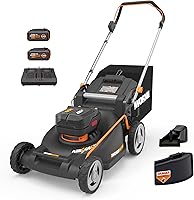
Are Greenworks Lawn Mowers Good?
Greenworks lawn mowers are good choices for regularly maintained lawns when you match the mower to your grass area, terrain, and battery needs. Choose the compact 40V for small lawns, the 60V push model for wider flat areas, or self-propelled drive to reduce pushing effort.
On this page (8 sections)
- Are Greenworks lawn mowers good for most yards?
- What are the main Greenworks mower trade-offs?
- Which Greenworks mower fits your yard?
- Does Greenworks offer a useful battery platform?
- Are Greenworks mowers powerful enough for thick grass?
- How should you set up and care for a Greenworks mower?
- How should you compare Greenworks mowers with other brands?
- Are Greenworks lawn mowers good for you?
Greenworks lawn mowers are good choices for regular cordless mowing when you choose the right size, drive type, and battery kit for your yard. Their appeal is simple: mowing without fuel handling, engine oil changes, or a power cord across the lawn.
The main buying mistake is choosing by voltage alone. A lighter push mower can suit a small, divided lawn better than a heavier self-propelled model, while a larger lawn needs enough battery capacity to finish without an awkward charging break.
Are Greenworks lawn mowers good for most yards?
Greenworks offers useful choices for small and medium lawns, plus a two-battery option with a larger claimed coverage area. The right fit depends on the grass you actually mow, rather than your property's total acreage.
Subtract the house, driveway, patios, and planting beds when estimating lawn area. Then consider how much time you spend turning around trees, crossing separate patches, or working along slopes.
Leave room below a mower's maximum coverage claim. Dense growth, frequent stops, and difficult terrain can turn an otherwise manageable lawn into a longer job.
For a broad comparison of battery options, read our cordless lawn mower buying guide. If you're deciding whether battery power suits your routine, see whether battery lawn mowers are any good.
What are the main Greenworks mower trade-offs?
The biggest trade-off is lighter handling versus a wider cut and drive assistance. Narrow mowers need more passes across open ground, but they can be easier to turn in small spaces.
Self-propelled drive helps move the mower forward. It doesn't remove the effort of turning, pulling back from a corner, or moving the mower over a threshold.
Think through the route from storage to grass before choosing. Steps, narrow gates, and tight shed entrances can matter as much as lawn size.
Battery ownership is another commitment. A matching platform can serve several yard tools, but batteries shared between a mower, blower, and trimmer must cover the whole day's work.
Which Greenworks mower fits your yard?
Choose the mower around your hardest regular mowing task. That might be tight corners, a long open stretch, uphill pushing, or keeping enough charged batteries ready.
Is the 40V 16-inch Greenworks mower good for a small yard?
The Greenworks 40V 16-Inch Push Mower (25322) is the best fit here for small lawns with frequent turns. Its 15.67-inch cutting width favors compact spaces over fast coverage of broad areas.
The mower weighs 37.5 lb and includes a battery and charger. Greenworks claims up to 1/3 acre with the included battery, depending on grass conditions and operator technique.
You get 5 cutting-height positions, and Greenworks backs the tool and battery with a 3-year limited warranty. That makes this a straightforward starting point if you want a complete kit for routine upkeep.
Skip it if you need drive assistance or have a wide lawn where extra passes would become tiring. Our Greenworks 40V 16-Inch Push Mower review covers this model in more detail.
Should you choose a 60V Greenworks push mower?
Choose the Greenworks 60V 21-Inch Push Mower for a mostly flat, open lawn when you're comfortable doing the pushing. Its 20.28-inch cutting width reduces the number of passes compared with the compact model.
Greenworks claims up to 1/2 acre from the included battery. The mower weighs 59.5 lb, so this is a better match for easy walking routes than repeated uphill runs.
Its modes cover mulching, bagging, side discharge, and turbo leaf pickup. Those choices help if you want to return clippings during routine mowing but collect them near paths or planting beds.
Greenworks provides a 4-year limited tool and battery warranty. Skip this model if reducing physical effort is your main reason for replacing a mower, since a wider deck doesn't provide powered movement.
Is a 60V Greenworks self-propelled mower good for a larger lawn?
The Greenworks 60V 21-Inch Self-Propelled Mower is the strongest fit here for longer mowing sessions where pushing effort matters. Its adjustable rear-wheel drive lets you choose a walking pace.
The kit includes a dual-port charger, and Greenworks claims up to 3/4 acre with its battery kit, depending on terrain and technique. That gives it the largest stated coverage area among these four options.
It has a brushless motor, a 20.28-inch cutting width, and 7 height positions from 1 to 4 inches. Greenworks backs the tool and batteries with a 4-year limited warranty.
At 65 lb, it still needs room to turn and a manageable storage route. Skip it if your tiny lawn is mostly short runs and awkward corners; read our Greenworks 60V self-propelled mower review for a closer comparison.
Is the Greenworks 80V self-propelled mower worth considering?
The Greenworks 80V 21-Inch Self-Propelled Mower makes the most sense for buyers choosing the 80V tool system. It combines a brushless motor and steel deck with variable-speed rear-wheel drive.
Greenworks claims up to 1/2 acre with the fully charged battery, depending on grass conditions and technique. Higher voltage therefore doesn't give this kit a larger coverage claim than the two-battery 60V option.
The mower weighs 75 lb, the most of these choices. Drive assistance helps while moving forward, but that weight matters if you need to lift it or maneuver around a crowded shed.
Greenworks includes a 4-year limited tool and battery warranty. Skip it if easy lifting is a priority or if you're choosing it solely because 80V sounds better than 60V.
Does Greenworks offer a useful battery platform?
A Greenworks platform is useful when several compatible tools share your batteries. Greenworks says each voltage system represented here supports more than 75 tools.
Keep those systems separate when planning your kit. Don't assume a battery will fit another Greenworks tool just because the brand name matches; check compatibility for the exact models.
Plan the mowing order, too. Using the same battery for trimming first can leave less charge for the lawn, so finish the largest job before moving to smaller tasks.
Our guide to how long a cordless mower battery lasts explains the conditions that change runtime. Avoid comparing amp-hour numbers across different voltages as though they describe equal stored energy.
Are Greenworks mowers powerful enough for thick grass?
These mowers are better suited to regular cuts than rescuing a badly overgrown lawn. The 60V push model adjusts power as grass demands change, while both self-propelled choices use brushless motors.
Good mowing habits still matter. Start with a higher cutting setting in tall grass, slow your walking pace, and avoid removing more than about one-third of the blade length at once.
If the mower struggles or leaves clumps, reduce the load rather than forcing it forward. A second cut after the lawn has recovered is better than trying to remove too much growth in one pass.
Prefer dry grass for cleaner handling and less clumping. Weather resistance doesn't remove wet-ground slip risks or replace the manual's operating limits.
Read whether electric lawn mowers are powerful enough for more on cutting demands.
How should you set up and care for a Greenworks mower?
Start with correct assembly, charged batteries, and a clear lawn. Follow the manual for handle fasteners, cable routing, battery installation, and the bag or discharge parts needed for your chosen mode.
Before the first cut, remove stones, branches, toys, and loose wire. Set a conservative cutting height and try the controls on a clear, level patch before tackling the full lawn.
On a self-propelled model, begin at a slow drive setting. Follow the manual's slope limits and mowing direction, since powered wheels don't make every slope suitable.
After mowing, switch off, remove the battery, and wait for moving parts to stop before clearing clippings or inspecting the deck. Follow the cleaning instructions rather than assuming the mower can be hosed down.
Keep the blade sharp and inspect it for damage. Store batteries and chargers within the manual's temperature limits, and let a hot battery cool as directed before charging.
Battery power removes engine-related chores, but blade care and cleaning still matter. Empty the bag promptly and clear packed grass so the next cut starts with an unobstructed deck.
How should you compare Greenworks mowers with other brands?
Compare equivalent complete kits, including drive type, cutting width, batteries, and charger. A bare mower and a two-battery kit serve different needs even if their deck sizes match.
Check replacement battery availability, blade availability, and service options before committing to a platform. Warranty length helps with planning, but it doesn't establish how long an individual mower will last.
Our EGO vs Greenworks comparison and WORX vs Greenworks comparison cover those alternatives. If drive assistance is your main uncertainty, start with self-propelled versus push mowers.
Are Greenworks lawn mowers good for you?
Greenworks lawn mowers are good choices when the kit fits your mowing routine. Pick the compact 40V for small spaces, or the 60V push mower for an open lawn you can comfortably mow without powered drive.
Choose the 60V self-propelled kit for reduced pushing effort and its larger stated coverage area. Choose the 80V model when that battery platform fits your wider tool plans and its weight suits your storage route.
If your lawn approaches a kit's maximum coverage claim, plan extra battery capacity or choose a kit with more headroom. Use our Greenworks 40V, 60V, and 80V mower guide to make the final platform choice.
Frequently asked questions
Are Greenworks lawn mowers reliable?
These specifications do not establish long-term reliability. Greenworks backs the compact 40V mower with a 3-year limited tool and battery warranty and these 60V and 80V models with 4-year limited coverage.
Read the terms and check access to replacement batteries, blades, and service before choosing a platform.
Which Greenworks mower is best for a small yard?
The Greenworks 40V 16-Inch Push Mower (25322) is the strongest fit here for a small lawn with tight turns. It weighs 37.5 lb and includes a battery and charger.
Choose a wider model for a broad, open lawn, or self-propelled drive if pushing effort is your main concern.
Should I get a 40V, 60V, or 80V Greenworks mower?
Choose by lawn layout, drive type, and battery compatibility before voltage. The compact 40V suits smaller spaces, while the 60V options offer a wider cut with a choice of push or self-propelled drive.
The 80V model makes sense for buyers who want drive assistance and matching 80V tools.
Are Greenworks mowers quieter than gas mowers?
Greenworks describes these mowers as quieter than gas models, but they still produce blade and motor noise. Lower noise does not remove the need to follow the manual's hearing-protection guidance.
Choose a reasonable mowing time, watch for people and pets, and keep enough daylight to see debris and uneven ground.