Are Battery Lawn Mowers Any Good?
Battery lawn mowers are good for many small and midsize yards with regular mowing and enough battery capacity to finish the job. Choose for your lawn's size, grass growth, and slopes, with extra coverage for demanding conditions.
On this page (7 sections)
- Are battery lawn mowers any good for everyday yards?
- What affects a battery mower's runtime and cutting?
- Do battery mowers work on hills and larger lawns?
- What are the tradeoffs of battery lawn mowers?
- How should you set up and care for a battery mower?
- Which buying mistakes should you avoid?
- Are battery lawn mowers any good for your situation?
Battery lawn mowers are good for regular lawn care when their battery capacity and cutting size match your yard. They're especially useful for small and midsize lawns where you want simple starts without fuel storage or an extension cord.
The deciding question is whether you can finish your normal mowing route comfortably. Grass height, slopes, narrow passages, and charging space matter more than choosing the highest voltage.
Are battery lawn mowers any good for everyday yards?
Yes, battery mowers suit lawns cut on a regular schedule, especially when one charge covers the work with room to spare. They're less convenient for large, overgrown areas that demand repeated charging breaks.
A compact push mower makes sense around beds and tight corners. A wider mower reduces passes across open grass, but it also needs enough clearance through gates and between obstacles.
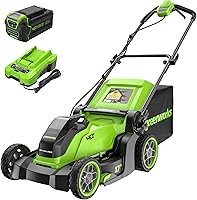
The Greenworks 25322 suits a smaller lawn where manageable weight matters more than covering broad stretches quickly. It weighs 37.5 lb, has a 15.67-inch cutting width, and offers mulching or rear bagging.
Greenworks says it covers up to 1/3 acre, depending on grass conditions and technique. Leave some room below that limit if your lawn has dense patches or you sometimes miss a mowing day.
Skip this model if you need powered drive or have a broad lawn where extra passes would become tiring. For tight layouts, compare the access and handling advice in our small-yard mower guide.
The cordless lawn mower buying guide explains how deck size, drive style, and battery systems work together.
What affects a battery mower's runtime and cutting?
Heavy grass and demanding terrain use battery energy faster than light, routine mowing. Start with the area you actually cut, then account for the conditions that make your route harder.
Measure grass separately from the house, driveway, and beds. If replacing another mower, time the cutting portion of a normal session, including turns and awkward sections.
Allow extra capacity rather than buying right at a stated coverage limit. A lawn that takes longer after rain or a missed cut needs more room than a simple area figure suggests.
The EGO LM2112 suits someone who wants a wider push mower for open sections and doesn't need powered wheels. Its 21-inch deck offers mulching, bagging, and side discharge, while its adjustable handle height helps you find a comfortable grip.
EGO gives up to 35 minutes of runtime with the included 56V 4.0 Ah battery. Skip this model if pushing is your main concern, or plan another battery if your usual route already takes that long.
Don't compare amp-hours across different voltages as if they're equal measures of stored energy. Our guide to how long a cordless mower battery lasts explains what runtime figures mean for daily use.
Are battery lawn mowers powerful enough for thick grass?
Battery lawn mowers can handle thick grass, but heavy growth calls for a slower pace and less grass removed per pass. Voltage alone doesn't establish which mower will cope best.
Start higher when the lawn is overgrown, then lower the deck for another pass if needed. Taking narrower strips also reduces the amount of grass entering the deck at once.
If the motor labors or clippings collect in clumps, ease off instead of forcing the mower forward. Stop and isolate the power as instructed before clearing a blockage.
A sharp blade cuts more cleanly than a dull one, which can tear grass tips. For more on cutting strength, read whether electric lawn mowers are powerful enough.
Do battery mowers work on hills and larger lawns?
They can suit larger lawns and permitted slopes, provided you choose enough battery capacity and the right drive style. Powered wheels reduce pushing effort, but traction and slope limits still control where you can mow.
The Greenworks 60V self-propelled mower suits a larger lawn where long stretches or inclines make pushing tiring. It has adjustable rear-wheel drive, a 21-inch deck, and two 4.0 Ah batteries.
Greenworks claims up to 3/4 acre of coverage, with results depending on terrain and technique. Its 65 lb weight also deserves attention if you must lift it over steps or load it for transport.
Skip it if your lawn is tiny and broken into narrow sections where handling matters more than powered travel. Follow its manual's slope limit and mowing direction, and avoid wet or slippery ground.
Read how a self-propelled mower works to understand the controls. Our self-propelled vs push mower comparison helps you decide whether reduced pushing effort is worth choosing a larger machine.
What are the tradeoffs of battery lawn mowers?
Charging time and eventual battery replacement are the main ownership tradeoffs. You avoid gasoline and engine oil, but you still need a charging routine and regular mower care.
Check replacement-battery availability before choosing a system. A mower that shares compatible packs with tools you use can simplify storage, though those tools may compete for the same charged batteries.
The WORX WG745 suits a compact yard with frequent turns and edges. It weighs about 40 lb, has a 16-inch cutting width, and offers mulching or bagging.
WORX claims coverage up to 1/4 acre. Its two included 20V 4.0 Ah batteries work together to power the mower, so they aren't a working pack plus a spare.
Choose it if compact handling and folding storage matter more than a wide cut. Skip it if you expect to swap between those two packs for a second full mowing session.
If charging breaks would regularly interrupt your work, compare electric vs gas lawn mowers before committing to a battery system.
How should you set up and care for a battery mower?
Charge the batteries, fit the correct clipping attachment, and start at a suitable cutting height before the first mow. Read the manual so you know the start sequence and how to isolate power safely.
Clear sticks, stones, toys, and other debris from the lawn. Set the handle so you can walk upright, then check that its locks and the battery are secure.
Choose bagging when you need to collect clippings, and empty the bag before it becomes packed. Mulching works best with short, dry clippings that can fall back into the lawn without forming piles.
As a general lawn-care rule, avoid removing more than about 1/3 of the grass blade at once. If growth is too tall, reduce it over separate cuts rather than scalping it in one session.
After mowing, let the blade stop and remove or isolate the battery as the manual directs. Clear built-up grass with the approved method, and inspect the blade and fasteners regularly.
Use the approved charger in a dry location and follow the battery's temperature and storage instructions. Don't leave packs in a hot vehicle, and follow the Consumer Product Safety Commission's battery safety guidance if a pack becomes damaged.
Which buying mistakes should you avoid?
Avoid sizing the mower by property acreage or voltage alone. Your actual grass area, usual mowing time, and physical handling needs give a clearer buying picture.
Check these points before choosing:
- Measure the narrowest gate. Deck names and cutting widths aren't the same as overall mower width.
- Count working batteries correctly. Some mowers use multiple packs together rather than keeping one in reserve.
- Plan the charging location. It should meet the charger's instructions and be convenient enough for regular use.
- Match the drive to your effort level. A push model remains a push model even with a powerful motor.
- Leave capacity for difficult cuts. Don't depend on reaching the maximum claimed area every time.
Don't treat weather resistance as permission to mow wet grass or wash the mower with a hose. Follow the manual's cleaning method and keep charging equipment dry.
Are battery lawn mowers any good for your situation?
Choose a battery mower when its coverage fits your routine with room to spare. If long charging breaks would be common, resolve that with compatible spare batteries or another power source before buying.
Pick the Greenworks 25322 for a small lawn and manageable weight, or the WORX WG745 for compact handling and folding storage. Choose the EGO LM2112 for wider push mowing, and the Greenworks 60V for powered travel across a larger lawn.
For the next decision, read whether electric lawn mowers are worth it and weigh charging convenience against the upkeep you're ready to leave behind.
Frequently asked questions
Are battery lawn mowers powerful enough for thick grass?
Battery lawn mowers can cut thick grass when you match the mower to the job and mow before growth gets too tall. Heavy growth uses more energy, so raise the deck, slow your pace, and take narrower passes if needed; keep the blade sharp and avoid wet grass.
How long can a battery lawn mower run?
Runtime depends on battery capacity, grass height, terrain, and mowing pace. A stated runtime is a planning guide, so leave room for turns, heavy patches, and slopes; compare it with your actual mowing time, and check whether a compatible spare battery would let you finish without a charging break.
Are battery lawn mowers worth it for a large yard?
Battery mowers can suit larger lawns if their coverage and battery setup leave enough room for demanding conditions; plan for charging or spare batteries when one charge won't finish the job. Self-propelled drive helps with pushing effort, but you still need to follow the mower's slope limits.
Do battery lawn mowers need less maintenance than gas mowers?
Battery mowers need less engine upkeep because they don't use gasoline, spark plugs, or engine oil. They still need a clean deck, a sound blade, secure fasteners, and proper battery care; follow the manual for charging and seasonal storage, and allow for battery replacement as the pack ages.