How Loud Is an Electric Lawn Mower?
Electric lawn mower decibels depend on the model, grass, and measurement method. WORX gives the WG779 an 87.8 dB noise figure, but comparable measurements are needed to identify the quieter mower.
On this page (8 sections)
- What do electric lawn mower decibels tell you?
- Are electric lawn mowers quieter than gas?
- How should you compare mower noise before buying?
- Which electric mower suits your yard and noise priorities?
- How can setup and mowing habits reduce strain and noise?
- What care helps prevent unusual mower noise?
- Should you wear hearing protection while mowing?
- Which mower should you choose if noise matters?
Electric lawn mower decibels vary by model and mowing conditions. WORX gives the WG779 an 87.8 dB noise figure, but comparable measurements are needed to tell whether another mower is quieter.
Choose for both sound and yard fit. A compact mower that needs many extra passes may keep you mowing longer, while a wider machine can be harder to move through narrow gates or around beds.
What do electric lawn mower decibels tell you?
Decibels describe sound on a logarithmic scale, so differences aren't simple percentages. A mower's number becomes useful when you know what was measured and under which conditions.
Sound pressure describes the sound at a particular location, such as the operator's position. Sound power describes the source's overall acoustic output, so don't rank mowers by mixing these measurements.
Look for the same measurement type, distance, and operating conditions. A figure taken while a blade spins freely doesn't describe exactly what you'll hear while cutting thick grass.
Distance and surroundings also matter. Sound at your handle position differs from sound across the yard, and nearby walls can reflect noise toward you or a neighbor.
Are electric lawn mowers quieter than gas?
Electric mowers remove gas-engine noise, but the blade, motor, and moving parts still make sound. Greenworks describes its 40V 17-inch mower as 30% quieter than gas, without supplying an exact decibel figure here.
You can't turn that percentage into a useful dB comparison without knowing what was measured and which gas mower served as the reference. It also doesn't establish a sound ranking among the 4 electric options below.
For the broader choice, read electric vs. gas lawn mowers. Noise belongs alongside cutting ability, battery needs, and the work involved in keeping the mower ready.
How should you compare mower noise before buying?
Compare matching sound measurements first, then choose a mower that can finish your lawn without awkward handling or frequent charging breaks. Quietness claims alone won't answer both questions.
Use these checks when narrowing your options:
- Exact model: Similar names and shared battery platforms don't mean identical noise.
- Measurement details: Match sound pressure with sound pressure, or sound power with sound power.
- Cutting conditions: Check whether the measurement represents mowing or a freely spinning blade.
- Yard layout: Allow for gates, trees, slopes, and strips between beds.
- Time to finish: Consider both cutting width and battery capacity.
Battery voltage isn't a noise score or a complete measure of cutting ability. Likewise, a brushless motor doesn't establish a particular decibel level.
Our guide to what brushless means on a lawn mower explains the motor choice. For the rest of your shortlist, use the complete cordless mower buying guide.
Which electric mower suits your yard and noise priorities?
The WG779 offers a numerical noise reference, while the other options serve different handling, battery, and yard needs. These facts support a practical shortlist, not a quietest-to-loudest ranking.
All 4 are push mowers. If pushing effort is your main concern, don't assume a bigger battery will reduce the work of moving the machine.
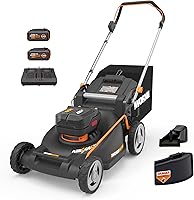
WORX WG779 electric lawn mower decibels
Choose the WG779 for a small lawn with tight spaces when you also want a published sound figure. WORX rates it for up to 1/8 acre, and it weighs 29.1 pounds.
Its 14-inch deck has a 13-inch cutting width, so expect more passes across open lawn than with either Greenworks option. Skip it if covering a broad area quickly matters more than compact handling.
The kit includes 2 20V 4.0Ah batteries and a dual charger. Its folding handle and carry handle also suit a shed where floor space is limited.
Greenworks 40V for an existing battery setup
Choose the Greenworks 40V for regular upkeep on a small to medium lawn, especially if you already use compatible Greenworks 40V tools. It includes a 4.0Ah battery and charger, with claimed runtime of up to 35 minutes.
Its 16.14-inch cutting width offers wider passes than either WORX option. Mulching and bagging let you leave short clippings on the lawn or collect them when needed.
Greenworks backs the tool and battery with a 3-year limited warranty. Skip it if your usual mowing session leaves little room within the claimed runtime, or if your purchase depends on a confirmed noise comparison.
Greenworks 60V for wider passes
Choose the Greenworks 60V for a more open lawn or a compatible Greenworks 60V tool setup. It has a brushless motor, weighs 37.5 pounds, and includes a 4.0Ah battery and charger.
Greenworks claims up to 40 minutes of runtime and a 90-minute full recharge. The brand also provides a 4-year limited tool and battery warranty.
Its 17-inch deck offers mulching and rear bagging. Skip it if frequent lifting is part of your routine, or if you need a numerical noise figure before buying.
WORX WG733.1 for frequent lifting and turns
Choose the WG733.1 for a small garden with obstacles, especially when carrying weight matters. At 21.7 pounds, it's lighter than the WG779 and Greenworks 60V models described here.
WORX says its included 20V 5.0Ah battery can cover up to 3,200 square feet per charge. The brushless mower includes a charger, bagging and mulching options, and a cut-to-edge design intended to reduce extra trimming.
Skip it for a large, open lawn where wider passes take priority. Its compact size supports handling, but doesn't establish lower sound output.
How can setup and mowing habits reduce strain and noise?
Start with dry grass, a suitable cutting height, and a clear lawn. These habits help avoid overloading the blade and reduce stops to clear clumps or debris.
Before the first mow, secure the handle as directed and fit the bag or mulch plug correctly. Set the cutting height with the mower stopped, then charge and install the batteries according to the manual.
Pick up sticks, stones, and loose objects before starting. Contact with debris can damage the blade and create sudden noise.
Avoid cutting an overgrown lawn to its final height in one pass. Start higher, walk more slowly through dense patches, and make another pass only when needed.
Use steady, slightly overlapping paths rather than repeatedly crossing the same area. For narrow lawns, the layout tips in best lawn mowers for small yards can help you choose between compact handling and wider coverage.
Plan runtime with room to spare. The guide to how long a cordless mower battery lasts explains why grass conditions can change how much lawn a charge covers.
What care helps prevent unusual mower noise?
Keep the blade and underside of the deck in good condition using the manual's care steps. Grass buildup, damage, and loose parts can change the mower's sound or cutting behavior.
Before cleaning or inspecting anything, stop the mower, wait for the blade to stop, and remove the battery as directed. Never reach underneath while power remains connected.
Remove accumulated clippings using the approved method, and don't assume you can hose down an electric mower. Keep battery contacts clean and dry, and follow charging and storage instructions.
Stop promptly if you hear new rattling, scraping, or knocking. Don't keep mowing to see whether it clears, and don't remove guards or change blade speed to chase quieter operation.
Should you wear hearing protection while mowing?
Follow the manual's hearing-protection guidance, even if the mower sounds quieter than a gas machine. Sound comfort alone doesn't establish safe exposure.
Mowing time matters as well as loudness. Use hearing protection intended for noise reduction when required, and don't treat ordinary music earbuds as an equivalent.
Keep children, pets, and bystanders outside the operating area at the distance required by the manual. Choose a reasonable mowing time and check any local noise restrictions.
Distance helps neighbors, but it doesn't remove noise at the handle. Avoid treating a quiet impression from across the yard as proof of what the operator experiences.
Which mower should you choose if noise matters?
For electric lawn mower decibels, choose comparable measurements before making a noise ranking. Then use yard size, handling, and charging needs to make the final choice.
Pick the WG779 for tight spaces and a numerical sound reference, or the WG733.1 when carrying weight is the stronger concern. Choose Greenworks 40V for compatible tools and regular upkeep, or Greenworks 60V for its runtime claim and longer limited warranty.
If sound is the deciding factor, get matching measurement details for your finalists before ordering. Read whether electric lawn mowers are powerful enough next to check that your quieter-mowing plan also fits your grass.
Frequently asked questions
How many decibels is an electric lawn mower?
Electric lawn mower decibels vary by model and cutting conditions. WORX gives the WG779 an 87.8 dB noise figure, but that number doesn't describe every battery mower.
For a useful comparison, check the measurement type, distance, and whether the mower was cutting grass when the sound was measured.
Are electric lawn mowers quieter than gas mowers?
Electric mowers generally avoid gas-engine noise, but their blades and motors still produce sound. Greenworks describes its 40V 17-inch mower as 30% quieter than gas.
That claim doesn't give an exact decibel level or establish how it compares with another electric mower, so compare model-specific measurements where available.
Should I wear ear protection with an electric lawn mower?
Follow the mower manual's hearing-protection guidance, even when the mower sounds quieter than a gas model. Battery power doesn't establish safe sound exposure.
Exposure depends on both sound level and mowing time, and ordinary earbuds aren't a substitute for hearing protection designed for noise reduction.
Does a battery mower get louder in thick grass?
A battery mower's sound can change when it cuts thick grass because the cutting load changes. The WORX WG779 adjusts blade speed to grass conditions, but no separate decibel figures are supplied for those changes.
Mow dry grass, slow your walking pace, and follow the manual's guidance for tall growth.